Staff augmentation vs outsourcing: which model fits
Staff augmentation vs outsourcing: who manages the work, who carries the delivery risk, what each really costs, and a five-question test for choosing.
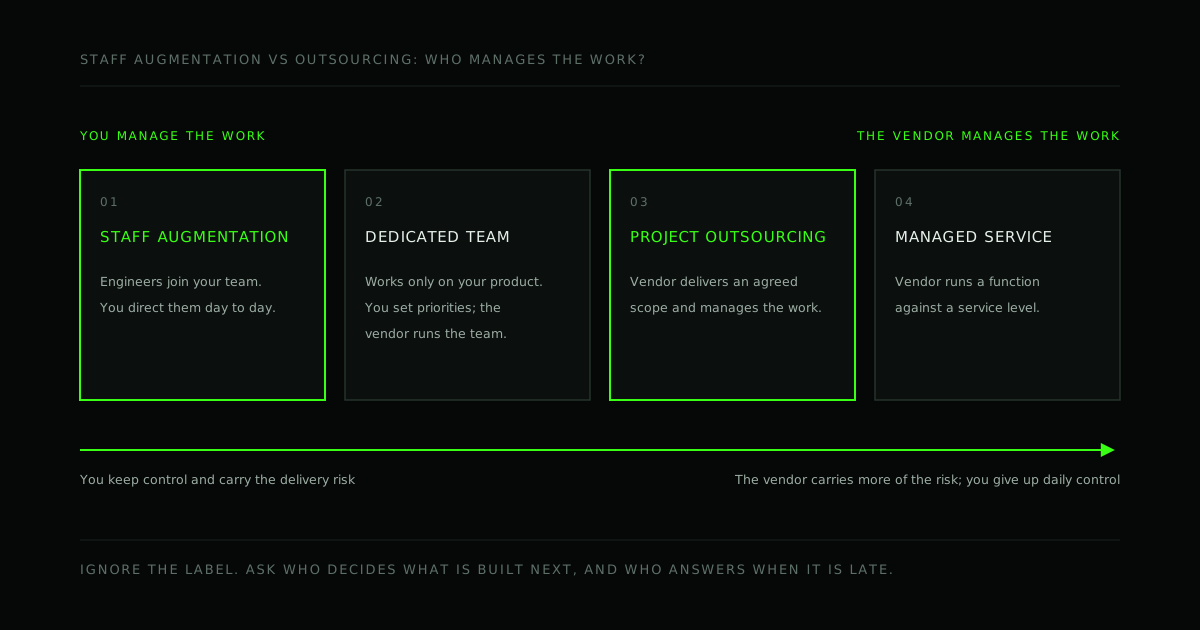
The difference between staff augmentation and outsourcing comes down to one question: who manages the work? With staff augmentation, outside engineers join your team and you direct them, so you keep control and you carry the delivery risk. With outsourcing, you hand a defined piece of work to a vendor who manages it and answers for the result, so you give up day-to-day control in exchange for handing over that risk.
Neither is cheaper or better in general. Each fits a different situation, and a capable vendor on the wrong model can still produce a failed engagement. This guide sets the two side by side, shows where a dedicated team sits between them, and ends with a five-question test you can apply to your own project.
What is staff augmentation?
Staff augmentation is hiring engineers from an outside company to work inside your team, under your management, for as long as you need them. They join your stand-ups, work in your repositories and your tracker, follow your engineering practices and take their priorities from your lead or product owner. The vendor employs and pays them; you direct them.
You are buying people's time and skills, usually priced per person per day or month. You are not buying a result. If the feature is late or wrong, that is a management problem on your side, the same as it would be with your own staff.
It works best when you already have an engineering team and a technical lead, and what you are short of is hands or a specific skill: a second React developer, a Flutter engineer for a mobile release, or someone who has built real-time video before.
What is outsourcing?
Outsourcing, in the sense buyers usually mean, is handing a defined piece of work to a vendor that plans it, staffs it, manages it and delivers it. You agree what will be built and how it will be accepted; the vendor decides how to get there and answers for getting there.
It comes in two common shapes:
- Project outsourcing: a defined scope delivered for a fixed price or on time and materials, with milestones and acceptance criteria. Building an MVP, an integration or an admin console are typical examples.
- Managed services: the vendor runs an ongoing function, such as maintenance, support or hosting, against an agreed service level.
You are buying an outcome, so the vendor carries more of the delivery risk. The price of that is less day-to-day control, and the need to describe what you want well enough for someone else to build it.
Staff augmentation vs outsourcing at a glance
| Staff augmentation | Project outsourcing | |
|---|---|---|
| Who manages the work | You (your lead or product owner) | The vendor |
| What you buy | Engineers' time and skills | A defined result |
| Who carries delivery risk | Mostly you | Mostly the vendor, within the agreed scope |
| How it is priced | Rate per person per day or month | Fixed price per milestone, or time and materials against a scope |
| What you must supply | Management, priorities, onboarding, code review | A clear scope, acceptance criteria and timely decisions |
| Changing direction | Easy: you just reprioritise | Needs a change to the scope or a change order |
| Where the knowledge stays | In your team and your codebase, as long as the work happens there | With the vendor unless hand-over is planned from day one |
| Speed to start | Fast once you have chosen the people | Slower: scope and plan come first |
| Typical failure | Engineers sit idle or drift because nobody on your side has time to direct them | The result matches the contract but not what you needed |
| Fits best when | You have a team and a lead, and need more capacity or a missing skill | You lack a team, or the work is self-contained with a clear definition of done |
Where a dedicated team fits
A dedicated team sits between the two. The engineers work only on your product, for an ongoing period, and you set the priorities, as with augmentation. But the vendor usually runs the team itself: day-to-day delivery management, cover for absences, and replacing people who leave. It suits long-running product work where you can steer but do not want to manage every engineer.
Vendors use these names loosely, and the same contract can be sold as any of the three. Ignore the label and ask two questions: who decides what is built next, and who answers when it is late? We cover the dedicated model in more detail in hiring a dedicated development team.
When staff augmentation is the better choice
- You already have a working team and a technical lead who can onboard, review and direct one or two more engineers.
- The gap is a skill, not a project: a mobile release, a WebRTC feature, a migration your team has not done before.
- Priorities change weekly, and you want to change them without renegotiating anything.
- You want the knowledge to stay in-house. The code is written in your repositories, reviewed by your people and documented to your standard.
- The need is temporary: a launch, a backlog spike, cover for a hire that has not started yet.
The condition behind all of these is management time. An augmented engineer needs the same onboarding, reviews and clear tickets as an employee. If your lead is already overloaded, adding people can slow the team down before it speeds it up.
When outsourcing is the better choice
- You do not have an engineering team, or the one you have is fully committed to something else.
- The work is self-contained: an MVP, an integration, an internal tool, a rebuild of one component, with a definition of done you can write down.
- You want one party accountable for delivering it, rather than managing the work yourself.
- You need skills you will not keep, such as a one-off platform build, and you do not want to manage people in that discipline.
Outsourcing works when the scope is clear enough to hand over. If it is not, spend a little money making it clear first: a short paid discovery, or scoping the first release yourself. Outsourcing a vague brief usually turns into a long argument about what was agreed.
A five-question test
Answer these in order. The first "no" usually decides it.
- Is there someone on your side who can direct engineers every day? If no, outsource (or take a vendor-managed dedicated team).
- Can you write down what "done" looks like? If no, outsourcing will be painful: run a discovery first, or augment your own team while the scope takes shape.
- Is the work self-contained, or tangled into your existing system? Self-contained work outsources well. Work that touches everything your team does is usually better done inside the team, with augmentation.
- How long will the need last? Weeks to a few months of extra capacity points to augmentation; a project with an end date points to outsourcing; months of evolving product work points to a dedicated team.
- Who should carry the delivery risk? If you want a vendor to answer for the result, outsource with milestones and acceptance criteria. If you prefer control, augment and carry the risk yourself.
How to compare the real cost
The day rate is the smallest part of the comparison. Put each option in the same terms before you choose.
For staff augmentation, add up:
- the rate per person multiplied by the days you expect to need them;
- your lead's time for onboarding, reviews and daily direction, which is real cost even though nobody invoices it;
- the ramp-up period before each new engineer is productive in your codebase.
For outsourcing, add up:
- the quoted price, and what it includes (project management, testing, deployment, documentation, hand-over);
- the realistic cost of changes, because scope that moves becomes change orders;
- your own time writing the scope, answering questions and accepting milestones.
Then ask each vendor to break its quote down into days and a rate, so the two models can be compared like for like. How to estimate what an app costs walks through doing that with real quotes.
Risks, and how to reduce them
| Risk | Staff augmentation | Outsourcing |
|---|---|---|
| Wrong people | Interview the actual engineers, not a sales lead, and start with one | Ask who exactly will work on it, and meet them before signing |
| Work drifts | Give augmented engineers the same tickets, reviews and definition of done as your team | Milestones with a working demo, and written acceptance criteria |
| Knowledge walks out | Keep all work in your repositories, reviewed by your team | Code in your organisation's repositories from day one; documentation and a runnable build as deliverables |
| Lock-in | Short notice periods; no exclusive clauses | Ownership of code and accounts settled in the contract; a hand-over plan |
| Time zones | Agree overlap hours as a written schedule | Agree when decisions and demos happen, and who answers questions overnight |
The buyer's guide to choosing a development partner has the full list of contract terms to settle whichever model you pick.
How this works with Daniotech
We work both ways. For staff augmentation we add developers to your team: they work in your repositories and your tracker, alongside your engineers, and take direction from your lead. For outsourcing we take on a defined project on a fixed price or time and materials, with a working demo at each milestone and the code in your repositories. Between the two, we also provide a dedicated developer or development team. Our stacks are React and Node.js on the web, Flutter and React Native on mobile, Electron on the desktop, and WebRTC for real-time audio and video.
Whichever model you choose, you own the code, and the agreement sets out how and when it passes to you. We are a US-registered company with our engineering team in Pakistan, working Monday to Friday, 9:00 AM to 6:00 PM PKT (UTC+5), and we can shift our hours by agreement to overlap more with your team. We do not publish rates; ask for a quote and we will break it down into days and rate so you can compare it with any other.
Frequently asked questions
Is staff augmentation a type of outsourcing? Loosely, yes: in both, people outside your company do the work. The difference is management. With staff augmentation you direct the engineers and answer for the result; with project outsourcing the vendor manages the work and answers for delivering the agreed scope. That is why the two are compared rather than treated as one.
Which is cheaper, staff augmentation or outsourcing? Neither, by default. Augmentation often has a lower headline rate but needs your management time, which is not on the invoice. Outsourcing includes the vendor's management but prices in risk and charges for changes. Compare total cost, including your own people's time, over the life of the work.
What is the difference between staff augmentation and a dedicated team? In both, engineers work on your product over an ongoing period and you set the priorities. With staff augmentation you also manage them day to day, inside your team. With a dedicated team the vendor usually runs the team: delivery management, cover for absences and replacements. Ask each vendor which of the two it is actually offering.
Who owns the code with staff augmentation? It should be you, and it should be written into the contract before work starts. Because augmented engineers work in your repositories, the code is in your hands from the first commit, but ownership of intellectual property is a legal question that the agreement has to settle explicitly.
Can we start with staff augmentation and move to outsourcing later? Yes, and it is a common path. Augmenting first lets you see how the engineers work in your codebase. Once a self-contained piece of work emerges, such as a mobile app or an integration, you can hand it over as a project with its own scope and milestones.
Where to go from here
If you need engineers in your team or a project delivered, see how you can hire developers from Daniotech on either model, or send us the problem, the users, the deadline and any existing code through the contact page. We will reply with the questions we would ask before recommending one.
- #Engagement models
- #Outsourcing
- #Hiring
- #Custom software
Working on this?
Planning a custom software project?
Send us the problem, the users and the deadline. We will reply with the questions we would ask before writing any code.