How to choose the right custom software development partner: a buyer's checklist
Custom or off-the-shelf? What to write down before you talk to vendors, ten questions to ask each one, how to compare proposals fairly, the contract terms that matter, and the red flags.
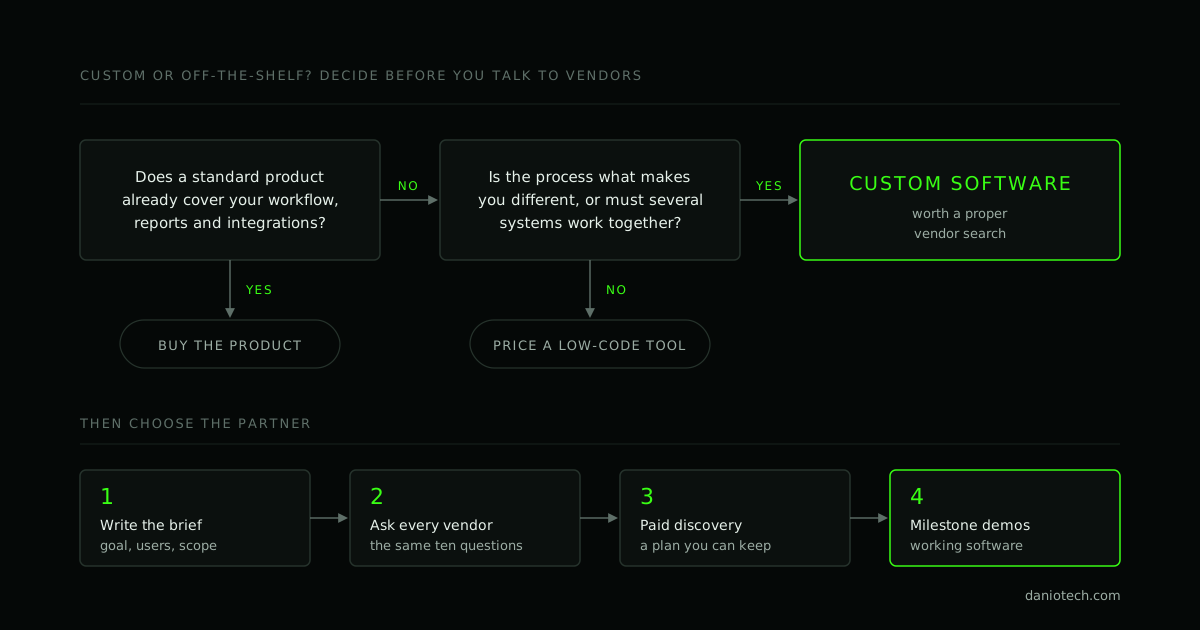
Choosing the right custom software development partner is usually a bigger decision than the project itself. The wrong fit costs budget, misses the business need, and leaves you with software that slows your team down — and you often find out after the money is spent.
This guide is a practical way to run the process: decide whether custom work is the right call at all, write down what you need, ask every vendor the same questions, compare proposals like for like, and put the right terms in the contract. It is written for the person who has to buy the software, not the person who will write it.
First decide whether custom software is the right call
The first decision is not which vendor to hire. It is whether custom software is the right path.
Off-the-shelf software is cheaper and faster to launch when a standard product already covers your workflow, reporting, security and integrations. Custom work earns its cost when one or more of these is true:
- Your team runs the core process on spreadsheets, workarounds or copy-and-paste between tools.
- The workflow is what makes your business different, and a packaged product would force you to change it.
- Several systems (CRM, ERP, payments, internal tools) have to work together in a way no standard product supports well.
- You expect to need new features or automation as you grow, and per-seat licensing would keep rising.
- Roles, approval rules or reporting are highly specific to how you operate.
If none of those apply, buy the product. If a low-code platform covers the requirement, price that too — it is a legitimate middle path for internal tools, though it can hit limits on performance, integrations and ownership.
The question to ask is not "can software do this?" but "can it do this in a way that fits how the business works now and in two years?" Lower upfront cost can hide higher long-term cost: manual work, duplicate data, a poor user experience and a product that cannot scale.
Write down what you need before you talk to anyone
Many teams start calling vendors before they can describe the problem. That produces vague proposals that cannot be compared. A one-page brief is enough:
| Section | What to write |
|---|---|
| Business goal | The outcome that would make this worth doing (fewer errors, faster onboarding, a new revenue line) — in words a non-technical colleague can check |
| Users and roles | Who uses it, what each role must be able to do, what they use today |
| Scope | What is in for the first release and what is explicitly out |
| Integrations | Every system it must read from or write to, and who owns each |
| Constraints | Budget range, deadline and why, data or compliance rules (privacy, payments, health data), accessibility requirements |
| Success measure | How you will know it worked after launch |
Share the same brief with every vendor. Their questions back are the first useful signal.
What a strong development partner looks like
A strong partner understands more than code. Look for evidence of these:
- They ask about your business first. They want to know how you make money, who the users are and what happens when the process fails — before they mention a technology.
- They can show relevant work. Similar scope, similar integrations, similar user experience demands. Ask what went wrong on a past project and what they changed afterwards; a team with no answer has either not shipped much or is not being straight.
- They test feasibility early. Anything risky (a third-party API you have never used, real-time features, performance targets, regulated data) should be tried in a small spike before it is priced as if it were routine.
- They explain their development process in plain language: discovery, design, build, testing, review, release, and what you will see at each step.
- They will say no. An honest partner tells you when an idea is too broad, risky or unlikely to pay back.
Communication matters as much as skill. Ask who will manage the work, how often you will meet, how problems are escalated, and how much of the working day you will share. See the section on time zones below.
Ten questions to ask every vendor
Ask all of them, in writing, and compare the answers side by side.
- Have you built products with similar business needs and scope? What did you learn?
- Do you run a paid discovery phase before a full estimate? What do I get from it?
- Who will work on my project day to day, and are they employees or subcontractors?
- How much of the working day will we share, and how do you handle the rest?
- How do you handle requirements that change mid-project?
- How do you assess scalability and technical feasibility early?
- What is your approach to testing, security and accessibility?
- How do you connect to the systems we already run?
- What does milestone-based delivery look like on this project?
- Will I see a working demo at every milestone — something I can click, not a slide?
Good answers are specific. "We follow best practices" is not an answer.
Compare proposals like for like
A proposal should do more than name a price. Compare the same things across every quote:
- What is included: discovery, design, testing, documentation, deployment, handover, training.
- The running cost, not just the build cost: hosting and cloud, licences, maintenance and support, upgrades, and your own team's time for reviews and rollout. A low estimate often hides missing testing, thin documentation or a weak handover.
- Return on investment: map the cost to something you can measure — hours saved, errors avoided, faster sales cycles, better reporting, better customer service. If no one on either side can state the expected return, the scope is not clear enough yet.
Pricing model. Fixed price works when requirements are stable and the scope is narrow, but it tends to turn every change into a change-order argument when the product is still taking shape. Time-and-materials suits work where discovery is still shaping the backlog — it lets you learn without pretending to a certainty nobody has. Whichever you choose, ask for milestone-based delivery with a working demo at each milestone. It gives you proof of progress and early feedback, and a much better handle on schedule risk than status reports.
Terms to settle before you sign
These affect your control of the product for years:
- Who owns the source code, designs and related IP — and when ownership passes to you.
- What handover looks like: repository access, documentation, deployment steps, credentials, environments.
- Support: what hours and response times are included after launch, and what a bug fix costs versus a change.
- Changes and delays: how scope changes are priced and how slipped dates are handled.
- Assumptions behind the timeline: what the schedule needs from your team (feedback turnaround, access, decisions) and what happens if that is late.
These points show whether a vendor is thinking past delivery.
Red flags
A proposal should leave you with fewer unknowns, not more. Treat these seriously:
- A fast quote with no discovery and no questions about your requirements.
- Vague wording on architecture, support or ownership.
- No clear answer on testing, security or accessibility — or accessibility "added at the end", when it affects design from the start.
- No working demo until final delivery.
- An unrealistic timeline with no assumptions listed.
- Broad promises about integration with no technical detail.
- Little overlap in working hours and no plan to make up for it.
- A team that cannot explain the trade-offs behind its recommendation.
Start small: a paid discovery phase
Strong teams usually recommend a small, paid discovery phase before a full build, because it reduces risk on both sides. It should end with a realistic plan: the business needs restated, the technical constraints, the integrations, the main user flows, an early architecture, and an implementation timeline with its assumptions. It is also the cheapest way to find out whether you can actually work with each other.
A sensible sequence: shortlist three vendors, send each the same brief and the same ten questions, then pay one or two of them for a short discovery — or a first milestone — and decide with real collaboration in front of you, not a sales deck.
Time zones and working hours
Be explicit about this up front, and ask every vendor the same. As an example of how to state it plainly: Daniotech is a US-registered company with its engineering team in Pakistan, working Monday to Friday, 9:00–18:00 PKT (UTC+5). That day ends around the time a New York morning begins, so overlap with US Eastern is short and overlap with the UK and Europe is much longer. Whatever a vendor's answer is, it should be a concrete schedule, not "we are flexible".
Frequently asked questions
How do I know if I need custom software or off-the-shelf software? Use custom software when standard tools do not fit your core process or growth plans — unique workflows, complex integrations, or rules that packaged products handle poorly. If a product already covers the need, buy it.
What should I ask during vendor selection? Ask about similar projects, the development process, testing, security and accessibility, how they handle changing requirements, who owns the code, and what the milestone demos look like. The ten questions above are a good start.
How important is integration? Very, if the software must work with a CRM, ERP, payment provider or internal systems. Weak integration work breaks data flow, creates manual work and undermines the value of the whole product. Ask for technical detail, not reassurance.
How can I compare software costs fairly? Compare the whole cost over time — build, hosting, maintenance, upgrades, your own team's time — and against a measurable return. Make sure every quote includes the same scope, testing and handover.
What makes a development partner trustworthy? Clear answers, realistic timelines, relevant evidence, willingness to explain trade-offs and to say no, and progress you can verify through working demos rather than reports.
Where to go from here
The best answer to "how do I choose the right custom software development partner" is rarely the cheapest bid or the biggest brand. It is the team that can connect your business goals, requirements and growth plans into a delivery approach that is realistic and well managed, and that behaves that way before you sign.
If you want to test that with us, contact Daniotech with your brief. If you are an early-stage team, start with custom software development for startups; you can also see the services page and try the live demo.
- #Custom software
- #Vendor selection
- #Buyer's guide
- #Outsourcing
Working on this?
Planning a custom software project?
Send us the problem, the users and the deadline. We will reply with the questions we would ask before writing any code.