Hiring a dedicated development team: how it works and what to settle first
What a dedicated development team is, when it beats a fixed-price project, and what to settle in writing before you hire dedicated developers.
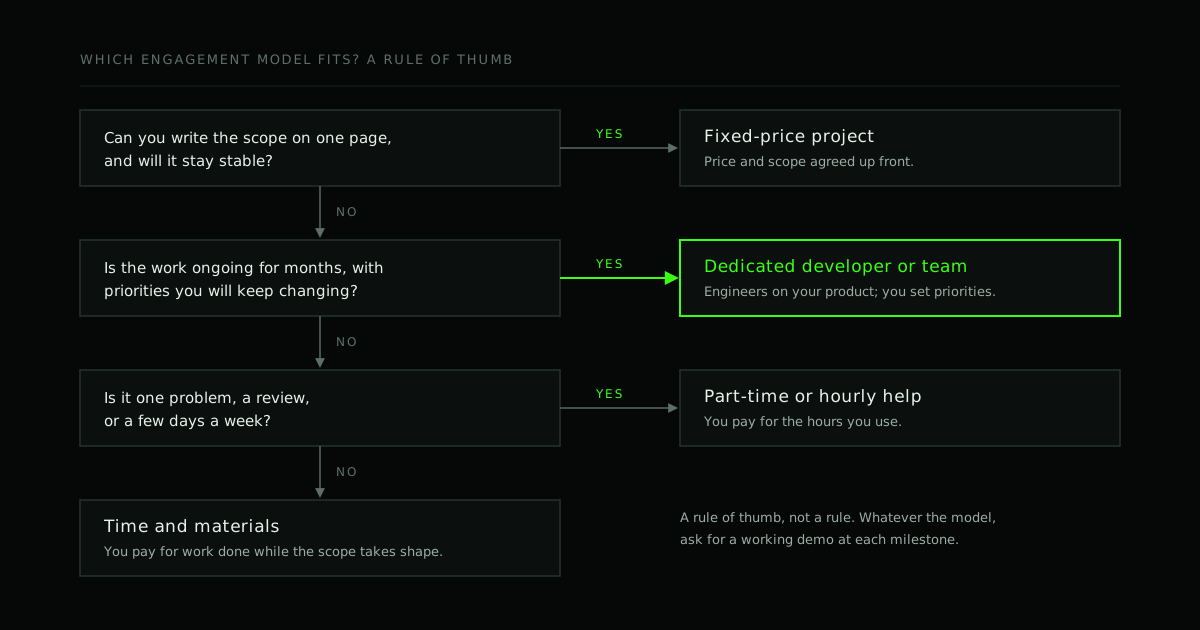
"Hire a dedicated development team" sounds like a product you can buy. It is an engagement model. You are not paying for a finished result. You are paying for engineers' time on your product, over an ongoing period, and you decide what they work on next. That is a good deal when the work is continuous and the priorities keep moving, and a poor one when the job is small, fixed, or still unclear.
This guide explains what a dedicated team is, how it differs from the other ways to hire, when to choose it, and what to settle in writing before you sign, whoever you hire.
Four ways to hire a developer
| Model | What you buy | Who carries the risk when scope changes | Fits when |
|---|---|---|---|
| Fixed-price project | A defined result for an agreed price | Mostly the vendor, which is why changes often become change-order arguments | The scope is narrow and stable |
| Time and materials | The work actually done, on a scope that is still taking shape | You, in exchange for flexibility | The direction is clear but the details are not |
| Dedicated developer or team | Engineers assigned to your product over an ongoing period | You steer, so you carry the risk of steering wrongly | The work runs for months and priorities keep changing |
| Part-time or hourly help | A few hours or days a week of an experienced engineer | Small, because the commitment is small | A review, a rescue, an architecture check or one feature |
The models overlap in practice and vendors use the names loosely. Ask what each one means in the contract: what is fixed (price, scope, people, hours) and who pays when something changes. How to estimate what an app costs shows how to compare quotes across models.
What "dedicated" actually means
- The people are assigned to your product for an ongoing period. Ask whether "dedicated" means full time on your product or a share of someone's week; the word is used for both.
- You set the priorities. The vendor supplies engineers and engineering practice. You, or a product owner on your side, decide what is built next.
- You pay for capacity, typically a rate per person for a day or a month, rather than for a deliverable.
- The scope can change without an argument, because the scope was never the thing you bought.
The last point is the appeal, and also the catch: with no fixed scope, nothing stops the work drifting unless you keep it pointed somewhere.
When a dedicated team is the right call
- The product will be worked on for months, not weeks, and the backlog keeps changing as you learn from users.
- Someone on your side can set priorities every week and say what "done" means.
- You want continuity: the same people learn the codebase and the domain, so later changes tend to get cheaper and safer to make.
- You already have a codebase or a lead engineer and need more hands, not a separate project.
When it is not
- The scope is narrow and stable. A fixed-price project with milestones is simpler to buy and to check.
- You cannot yet say what the first release is. Settle that first, with a short paid discovery or by scoping an MVP. A team with no direction burns money quickly.
- It is one problem. A code review, a rescue or a single integration is part-time work.
- Nobody on your side can steer. A dedicated team does not replace a product owner. If you have none, a fixed scope or a vendor-led project fits better.
Questions to settle before you hire
Ask every vendor the same questions, get the answers in writing, and treat vague answers as answers.
- Who exactly will work on it? Can you meet them before you commit, and what have they built in your stack?
- What happens if one of them leaves? How quickly is someone replaced, and who covers the hand-over so you do not pay for the new person to learn from scratch?
- How is work prioritised and shown? A weekly demo of working software beats a weekly report.
- Where does the code live? Repositories in your organisation from day one, with you holding the admin rights, not a copy handed over at the end.
- Who owns the code, and when does ownership pass? It should be written down before work starts.
- How do you start and how do you stop? Ask about any minimum term, the notice period, and what you receive at the end (documentation, a build you can run without the vendor).
- What is the schedule? Working hours and overlap with your time zone, as a concrete schedule and not "we are flexible".
- How is the cost stated? A rate per person, what it includes (management, testing, tools), and what happens to the price if the team grows or shrinks.
- What if it is not working? A short first period and a clean exit protect both sides.
Start small and keep the exit open
- Begin with a paid discovery or a first milestone. It shows how the collaboration works before you commit to months of it. The buyer's guide covers what a good discovery should produce.
- Start with one developer or a small team and grow it when you know the work justifies it.
- Write down what "done" means for each milestone, and have it shown to you running.
- Plan the hand-over from the first week: tests, documentation and a build your own team could run. If you ever leave, you should be able to.
Red flags
- You cannot meet or name the people who will do the work.
- The vendor holds the only copy of the repository, the credentials or the cloud accounts.
- Ownership of the code is "to be discussed", or is missing from the contract.
- A long minimum term is required before you have worked together.
- The price is given without saying what it includes.
- Every answer to a scheduling question is "we are flexible".
How this works with Daniotech
We work in all four models above, including a dedicated developer or development team. You own the code (how and when is set out in the agreement), and we can review, take over or continue an existing codebase, or work alongside your own team. For larger work we recommend a short, paid discovery first, and we ask for a working demo at each milestone.
We are a US-registered company with our engineering team in Pakistan, working Monday to Friday, 9:00 AM to 6:00 PM PKT (UTC+5). That day ends around the start of a New York morning, so overlap with US Eastern is short and with the UK and Europe much longer. We can shift our hours by agreement to overlap more with your team. We do not publish rates, because they depend on the scope and the people; ask for a quote and we will break it down into days and rate so you can compare it. Put the questions above to us too.
Frequently asked questions
What is the difference between a dedicated team and outsourcing? Outsourcing says who does the work: someone outside your company. A dedicated team describes how the engagement is shaped: ongoing capacity assigned to your product. You can outsource a fixed-price project or a dedicated team, so choose by the work, not by the word.
How long should I hire a dedicated team for? Long enough that continuity pays off, and short enough that you can stop when your priorities change. Ask each vendor for any minimum term and the notice period in writing before you compare prices.
Can I hire just one dedicated developer? Often, yes, and it is a sensible way to start. Ask whether the developer works full time on your product, and who covers when they are away.
How much does a dedicated developer cost? It depends on the person, the stack and how long the work runs. Compare quotes as days multiplied by a rate, with the same inclusions on each, and be wary of a low rate that leaves out management, testing or hand-over.
Do I need a project manager or product owner? Someone on your side has to decide priorities and accept work as done. A vendor can bring delivery management, but it cannot decide what your product should do.
Where to go from here
If you already know you need engineers, see how you can hire dedicated developers from Daniotech, or send us the problem, the users, the deadline and any existing code: contact us and we will reply with the questions we would ask before starting. If you are an early-stage team, start with custom software development for startups.
- #Custom software
- #Hiring
- #Engagement models
- #Outsourcing
Working on this?
Planning a custom software project?
Send us the problem, the users and the deadline. We will reply with the questions we would ask before writing any code.