Venture builder, startup studio, consultancy or MVP development company: which does a founder need?
What a venture builder, a startup studio, a startup consultancy, a product design studio and an MVP development company each do, how you pay each one, what you keep, and how to choose.
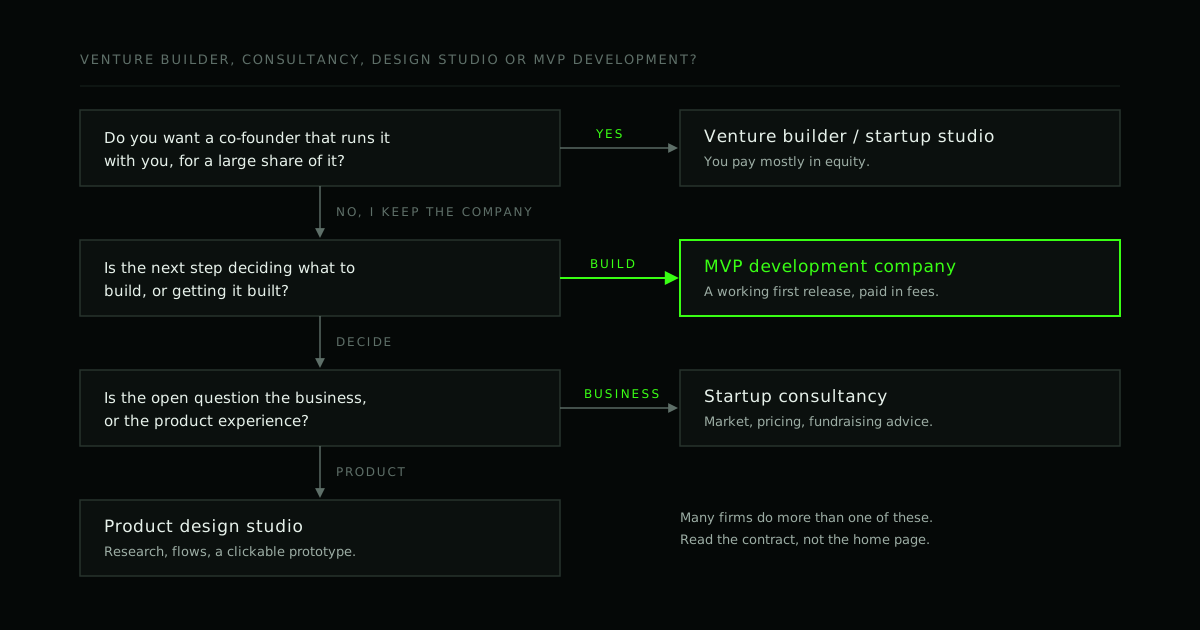
Search for help with a new product and you meet five kinds of firm that sound alike: a venture builder, a startup studio (or venture studio), a startup consultancy, a product design studio and an MVP development company. Their websites use the same words: idea, validation, launch, scale. What they sell is very different, and so is the price. Some are paid in cash, some in a share of your company, and some in both.
This guide sets out what each one does, how you pay for it, what you keep at the end, and how to tell which one your situation calls for.
The short version
| Kind of firm | What you get | How you usually pay | What you keep |
|---|---|---|---|
| Venture builder / startup studio | A company built with you, or around you: people, process, often money | A large share of the company, sometimes with fees | The part of the company the studio does not hold |
| Startup consultancy | Advice: strategy, market, pricing, fundraising, operations | Fees: by the day, the project or a retainer | All your equity, plus a set of recommendations |
| Product design studio | Research, user flows, interface design, a clickable prototype | Fees, usually per project | The designs and the research; working software is usually a separate job |
| MVP development company | A working first release that real users can use | Fees: fixed price, time and materials, or a dedicated team | All your equity, and the code (check the contract) |
The names are used loosely. Many firms do two or three of these things, and a firm calling itself a "venture studio" may in practice be a development company with an equity option. Read the contract, not the home page.
What a venture builder or venture studio is
A venture builder creates new companies, again and again, from a shared team. It usually starts with its own ideas, tests them, and spins out the ones that work as separate companies. It then recruits founders or chief executives to run them. Some also take in outside founders who arrive with an idea.
What makes it a venture builder is not the service but the ownership: it is a co-founder of each company, not a supplier to it. It supplies product, engineering, design, recruiting, legal and finance people from a central pool, and often the first money as well. In return it holds a large share of each company, often much more than an investor would at the same stage.
Startup studio and venture studio usually mean the same thing. Some people use "venture builder" for studios that work with corporations, building new ventures for an established company, and "startup studio" for those that create independent startups. The distinction is not consistent.
A venture builder suits you when:
- You want to start a company but do not have, or do not want to assemble, a team.
- You value the studio's process, network and capital more than the equity you give up.
- You are comfortable with a co-founder that is also an institution with its own portfolio and priorities.
It does not suit you when you already have the idea, the team or the money and want to keep control. Then you are paying in equity for things you could pay for in cash.
Startup consulting: what a consultancy does
A startup consultancy sells advice; startup consulting is paid for by the day, the project or a retainer. Typical work: testing whether a market exists, positioning and pricing, a go-to-market plan, preparing for fundraising, setting up operations or hiring. Some consultancies specialise in technology strategy: choosing a stack, planning the product, estimating a build.
You pay fees and keep your equity. What you get at the end is a set of findings and recommendations. Whether anything is built is up to you.
A consultancy suits you when the open question is the business: who buys, at what price, through which channel, with what money. It suits you less when the open question is "can someone build this?". Advice will not answer that, and paying for a strategy deck before a single user has touched the product can postpone the evidence you need.
What a product design studio does
A product design studio (or product design agency) works out how the product should behave and look. Typical work: user research and interviews, journeys and flows, wireframes, the visual interface, a design system and a clickable prototype you can put in front of users.
You pay fees and keep the designs. A prototype is not a product: it shows the idea but usually does not store data, take payments or run on real infrastructure. Some design studios also build. Many hand the designs to a development team.
A design studio suits you when the open question is the product experience: the market is clear but nobody has worked out what the user does, screen by screen. It also suits teams whose product lives or dies on its interface.
What an MVP development company does
An MVP development company builds the first working release of your product: the smallest version that can test your riskiest assumption with real users. A good one also challenges the scope, because the main way an MVP fails is by being too big.
You pay fees, under one of the usual engagement models: fixed price for a stable scope, time and materials while the scope takes shape, a dedicated developer or team for ongoing work, or part-time help. You keep your equity. You should also own the code, but that depends on the contract, so check it.
It suits you when you know what to test and need it built: the problem is real, the first user is named, and the next step is software that people can use. MVP development: how to decide what goes in the first release explains how to get to that point.
How to choose
Ask three questions, in this order.
- Do you want a co-founder, or a supplier? If you want another party to share the risk, the decisions and the company, in exchange for a large part of it, talk to venture builders and studios. If you want to keep the company, hire for cash.
- Is the next step deciding, or building? If you cannot yet say what the first release is, the next step is deciding. If you can write it on one page, the next step is building.
- If deciding: is the open question the business or the product? The business (market, pricing, fundraising) is consultancy work. The product (what the user does, screen by screen) is design studio work.
These are not exclusive. A common, sensible order is a short piece of research or design, then an MVP, then a decision based on what users did. What wastes money is paying for the wrong step: equity for services you could buy, a strategy deck when the question is technical, or a full build when the scope is still a guess.
Questions to ask any of them
Whatever kind of firm you talk to, get these answers in writing:
- What exactly do I pay, and in what? Cash, equity, or both. If equity: how much, when it vests, and what happens to it if the work stops.
- What do I own at the end? The company, the code, the designs, the accounts, the domain. Ask whether ownership of the code and designs is written into the contract, and when it passes to you.
- Who will do the work? Names and what they have built. Can you meet them before you commit?
- What will I see, and how often? Working software or a clickable prototype at each milestone beats a status report.
- What happens if it does not work? How each side stops, and what you take with you.
- What are you not going to do? A good firm will tell you where its job ends, whether that is fundraising, design, engineering or running the company.
Red flags
- An equity stake is asked for instead of a fee, for work that is really a service.
- Ownership of the code or the designs is "to be discussed" or missing from the contract.
- The firm holds the only copy of the repository, the cloud accounts or the domain.
- Nobody challenges the scope, so everything you asked for is quoted.
- You cannot name the people who will do the work.
- The answer to "what if this fails?" is that it will not.
Where Daniotech fits
Daniotech is a software development company, so of the five, we are the last one: an MVP development company. We are not a venture builder or an investor. We build web, mobile and desktop products (React and Node.js, Flutter, React Native, Capacitor, Electron), and we will push back on scope until the first release is small enough to ship.
We work in four models: fixed price, time and materials, a dedicated developer or team, and part-time or hourly help. You own the code (how and when is set out in the agreement), and for larger work we recommend a short, paid discovery first. We are a US-registered company with our engineering team in Pakistan, and we ask for a working demo at every milestone.
Frequently asked questions
What is the difference between a venture builder and an accelerator? An accelerator runs a fixed programme for startups that already have founders: mentoring, a network and usually a small investment, for a small share. A venture builder creates the companies itself, provides the team, and holds a much larger share.
What is the difference between a venture builder and a startup studio? Usually none: both create companies from a shared team and take a large share in return. Some people reserve "venture builder" for studios that build new ventures for established corporations.
Do venture builders invest money? Many do, from their own fund or with partner investors, but not all. Ask what is invested, on what terms, and how much of the company you would keep.
Should I give equity to a development company? Only if you would also take that company on as a co-founder, with its say in the company. For work that has a clear scope and a price, paying in cash keeps your company and keeps the relationship simple.
Can a startup consultancy build my MVP? Some have engineering teams; many do not. If the deliverable you need is working software, ask to see software they have shipped and who will write the code.
Do I need a product design studio before an MVP? Not always. If the product's value depends on a new or complex interface, design first. If it is a known kind of product (booking, a dashboard, a marketplace), the development team can design the first release with you and test it with users.
Where to go from here
If you know what you want to test and need it built, see our MVP development services and custom software development for startups. If you are comparing vendors, the buyer's guide covers what to ask. Or send us the problem, the users and the deadline: contact us and we will reply with the questions we would ask before building anything.
- #Startups
- #MVP
- #Engagement models
- #Custom software
Working on this?
Planning a custom software project?
Send us the problem, the users and the deadline. We will reply with the questions we would ask before writing any code.