DevOps consulting: what a good engagement delivers
DevOps consulting explained: what a consultant does, the deliverables you should hold at the end, a phase-by-phase plan, costs and the red flags to avoid.
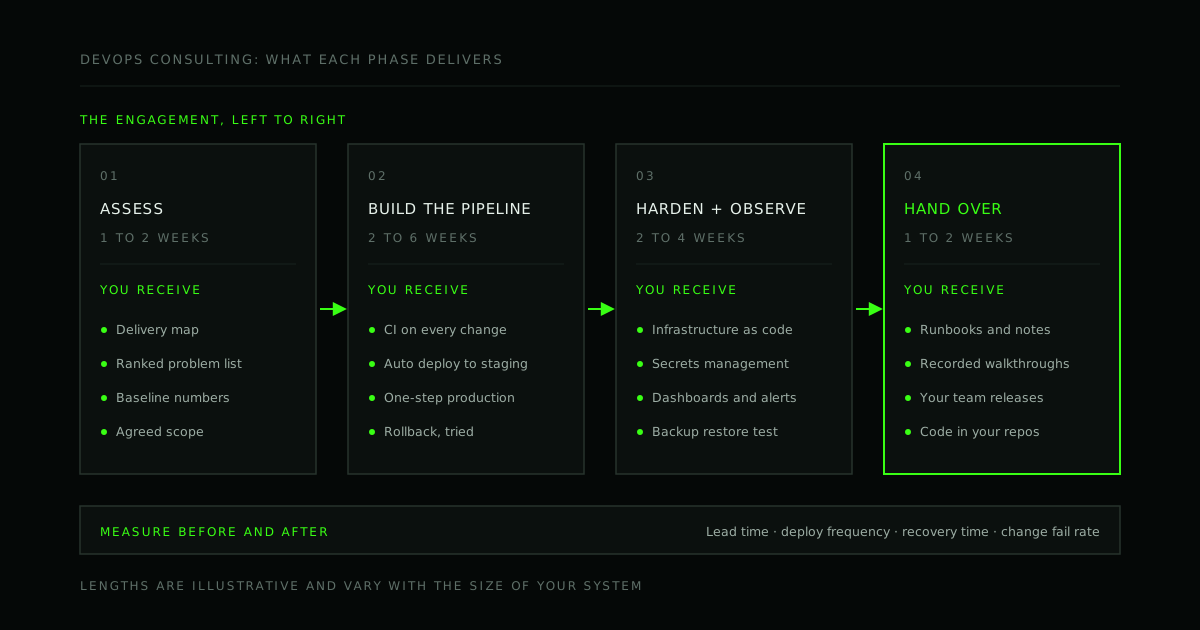
DevOps consulting is paid, outside help to get software from a developer's machine to production faster and more safely: automated builds and tests, repeatable infrastructure, reliable releases and monitoring that tells you when something breaks. A good engagement ends with working pipelines, written runbooks and a team that can run them without the consultant.
This guide is written from the delivery side. It covers what a consultant does, what you should receive, how long it takes, how we ship our own sites, and the warning signs of an engagement that sells tools instead of results.
What does a DevOps consultant do?
A DevOps consultant looks at how your code reaches users, finds the slow, manual or risky steps, and fixes them with automation, then leaves your team able to keep it running. The job is mostly plumbing and habits, not a single tool.
In practice the work falls into five areas:
- Assessment. Reading repositories, deployment scripts, cloud accounts and incident history, and talking to the people who release the software.
- CI/CD. Building pipelines that compile, test and package on every change, and deploy in a controlled way.
- Infrastructure as code. Describing servers, networks and databases in version-controlled files (Terraform, Pulumi, CloudFormation or similar) so environments can be rebuilt, not hand-tuned.
- Observability and incident response. Logs, metrics, traces, alerts that wake the right person, and runbooks for the common failures.
- Security and cost hygiene. Secrets handling, least-privilege access, dependency scanning, backups that are actually restored in a test, and a look at the cloud bill.
Some engagements cover all five. Many are narrower, for example "fix our release process" or "move us onto containers."
When does a company need DevOps consulting?
You need it when releases are slow, scary or dependent on one person, or when infrastructure has grown by accident. A few signals:
- Deployments happen at night, by hand, from one engineer's laptop.
- "It works on my machine" is a regular sentence.
- Staging and production differ in ways nobody can list.
- An outage took long to diagnose because logs or metrics were missing.
- Your cloud bill rises faster than your usage and nobody can explain it.
- You are about to scale (more developers, more customers, a new region) on foundations that will not carry it.
If you have one developer and a simple app on a managed platform, you probably do not need a consultant. A day of review may be enough.
What should a good engagement deliver?
You should end with things you can open, run and hand to a new hire: a delivery map, working pipelines, infrastructure code, monitoring with alerts, runbooks, and a recorded handover. If the main output is a slide deck, be careful.
| Phase | Typical length (varies with size) | What you should receive |
|---|---|---|
| 1. Assess | 1 to 2 weeks | A map of how code reaches production today, a ranked list of problems with their cost, an agreed target and scope |
| 2. Build the pipeline | 2 to 6 weeks | CI that runs tests on every change, automated deploys to staging and production, rollback that has been tried |
| 3. Harden and observe | 2 to 4 weeks | Infrastructure as code for the agreed environments, secrets management, dashboards, alerts, backup restore test |
| 4. Hand over | 1 to 2 weeks | Runbooks, architecture notes, recorded walkthroughs, your team doing a real release with the consultant watching |
These durations are illustrative, not a promise; they depend on how many services you run and how tangled they are. Ask any consultant to explain theirs.
How does a typical project run, step by step?
It runs as a loop of small, shippable changes, not a big-bang rewrite. A common sequence:
- Agree what "better" means. Pick two or three measures and record today's value. The DORA research programme tracks five software delivery measures: change lead time, deployment frequency, failed deployment recovery time, change fail rate and deployment rework rate. Most teams start with the first three.
- Map the current path to production, including every manual step and who does it.
- Pick the first bottleneck and fix it end to end. Often this is automated tests plus a one-command deploy.
- Put the pipeline in version control next to the code, so changes to it are reviewed like any other change.
- Describe infrastructure as code, starting with the environment that hurts most.
- Add monitoring before you need it, with alerts tied to user-visible symptoms, not every CPU spike.
- Run a failure drill: restore a backup, roll back a release, kill a server. Fix what the drill exposes.
- Hand over. Your engineers run the next release while the consultant observes.
A worked example (hypothetical)
Take an invented product: a web app with an API, a database and a mobile client, deployed by one engineer running a shell script from their laptop. Releases take about half a day, happen monthly, and two of the last six needed a manual fix afterwards. These numbers are made up for illustration.
A sensible plan would not start with Kubernetes. It would be:
- Week 1: map the release, write down the manual steps, add a smoke test that confirms the app is up after deploy.
- Weeks 2 to 3: CI that builds and runs the existing tests on each pull request; deploy to staging automatically on merge.
- Weeks 3 to 4: production deploy as a button press with an automatic rollback if the smoke test fails.
- Weeks 5 to 6: infrastructure described as code, basic dashboards and two alerts (site down, error rate high), a runbook for each.
- Week 7: the team does a release alone.
The result would be measured against the starting point: shorter release time, fewer post-release fixes, and no single person holding the process in their head. If the numbers did not move, the engagement did not work, whatever tools were installed.
How do we ship our own sites?
Our own websites deploy on every push to the main branch, with a health check and an automatic rollback. It is a small setup, and that is the point: the simplest pipeline that removes the manual steps.
- A push to the deploy branch starts a GitHub Actions workflow. Nobody deploys from a laptop.
- The workflow sends the committed code to the server over SSH with a restricted deploy key, which can run the deploy command and nothing else. The key and the server's fingerprint live in the repository's encrypted secrets.
- The server builds the release next to the current one, switches to it, then checks that the site answers.
- If the check fails, it switches back, so the previous release stays live and the failed run is there to read.
There is no Kubernetes and no service mesh, because a handful of web apps on one server do not need them. When a client's system is bigger, the same principles scale up: every change goes through the pipeline, every release can be undone, and the pipeline itself is code.
How much does DevOps consulting cost?
Cost follows effort: the number of services, how much already exists, how many environments, and how much your team can do alongside. We do not publish rates here, and anyone quoting a price without seeing your setup is guessing.
What to compare between proposals:
- The deliverables list, not the tool list.
- Whether handover is a named phase. If it is missing, you are buying dependence.
- The engagement model. Fixed price suits a clearly bounded job such as "build a pipeline for these two services." Time and materials suits discovery-heavy work. A part-time arrangement suits ongoing improvement. See staff augmentation vs outsourcing for how these differ, and how to estimate app development cost for a three-point estimating method that works for infrastructure too.
- Who does the work. Some firms sell with a senior and deliver with a junior.
Is DevOps still in demand, highly paid, or being replaced by AI?
Demand is still there because every team that ships software has to deploy and operate it, and cloud services have made that work more complicated, not less. On pay, the 2025 Stack Overflow Developer Survey put the global median salary for "DevOps engineer or professional" at $87,011 a year, above back-end ($79,742) and full-stack ($72,509) developers. In the United States the DevOps median in the same survey was $165,000. These are self-reported medians from survey respondents; pay in your market will differ.
AI tools now write pipeline files, Terraform and runbooks quickly. They do not know your system, your risks or what to do at 3 a.m. when the generated config has quietly opened a database to the internet. The skill shifts towards reviewing, testing and designing, which is why human review of AI-written code matters here as much as anywhere. We treat AI as a faster pair of hands under review, not a replacement for the person accountable.
What are the red flags in a DevOps proposal?
The main ones are tool-first thinking, no measurable goal, and no plan to leave. Watch for:
- A recommendation (Kubernetes, a specific vendor) before anyone has looked at your system.
- No baseline numbers, so no way to prove improvement.
- "Lift and shift to the cloud" presented as DevOps. Moving servers is not changing how you deliver.
- Access requests that are far broader than the task, such as permanent admin on everything.
- Pipelines only the consultant can edit.
- No restore test for backups.
- No handover phase, no documentation deliverable.
How do you hire the right consultant or firm?
Ask for a first small, paid piece of work with a clear output, and judge by that. Questions that tell you the most:
- "What would you look at first in our setup, and why?"
- "How will we know in a month that it is working?"
- "What happens to the code and accounts when you finish?" The pipelines and infrastructure code should live in your repositories, and the agreement should say who owns what.
- "Show us a runbook and a pipeline from past work, with sensitive details removed."
- "Which parts will our team be able to maintain, and which are likely to need you again?"
Our own terms are simple to state: a paid discovery phase is offered (we recommend it for larger work), then a defined scope under a fixed-price, time-and-materials, dedicated-team or part-time model, and you own the code, with how and when set out in the agreement. DevOps and CI/CD pipelines sit under the enterprise web and cloud work on our services page, and the same thinking applies to choosing a development partner. If your real-time or video stack is the pain point, why WebRTC calls fail and coturn in production cover the infrastructure side.
Frequently asked questions
What does a DevOps consultant do? A DevOps consultant reviews how your software moves from code to production, then automates builds, tests, deployments and infrastructure, adds monitoring, and documents it all. The goal is faster, safer releases that your own team can run without ongoing outside help.
Is DevOps highly paid? Generally yes. In the 2025 Stack Overflow Developer Survey, the global median for DevOps engineers was $87,011 a year, above back-end and full-stack developers, and $165,000 in the United States. Pay still varies a lot by country, seniority and company size, so check figures for your own market.
Is AI replacing DevOps? Not in the sense of removing the need for it. AI assistants speed up writing pipelines and infrastructure code, but someone still has to design the system, review the output, handle incidents and own the risk. The work moves towards review and design.
Is DevOps still in demand in 2026? Yes. Any team that ships software needs reliable deployment and operations, and cloud, security and cost control have added to that work. Job titles shift towards platform and site reliability engineering, but the underlying skills remain in demand.
How long does a DevOps consulting engagement last? A focused project, such as a CI/CD pipeline for a couple of services, can take a few weeks. Broader work covering infrastructure as code, monitoring and handover often runs a few months. The scope and your team's availability decide it.
Where to go from here
If your releases are slow or fragile, send us how you deploy today and what hurts. We will reply with what we would check first and how we would scope it. Send requirements, or look at the engagement models on /hire.
- #DevOps
- #CI/CD
- #Cloud infrastructure
Working on this?
We build and fix real-time systems.
If your calls fail for a subset of users and you can't reproduce it, that's diagnosable. Take a live demo call and we'll walk the architecture with you.